
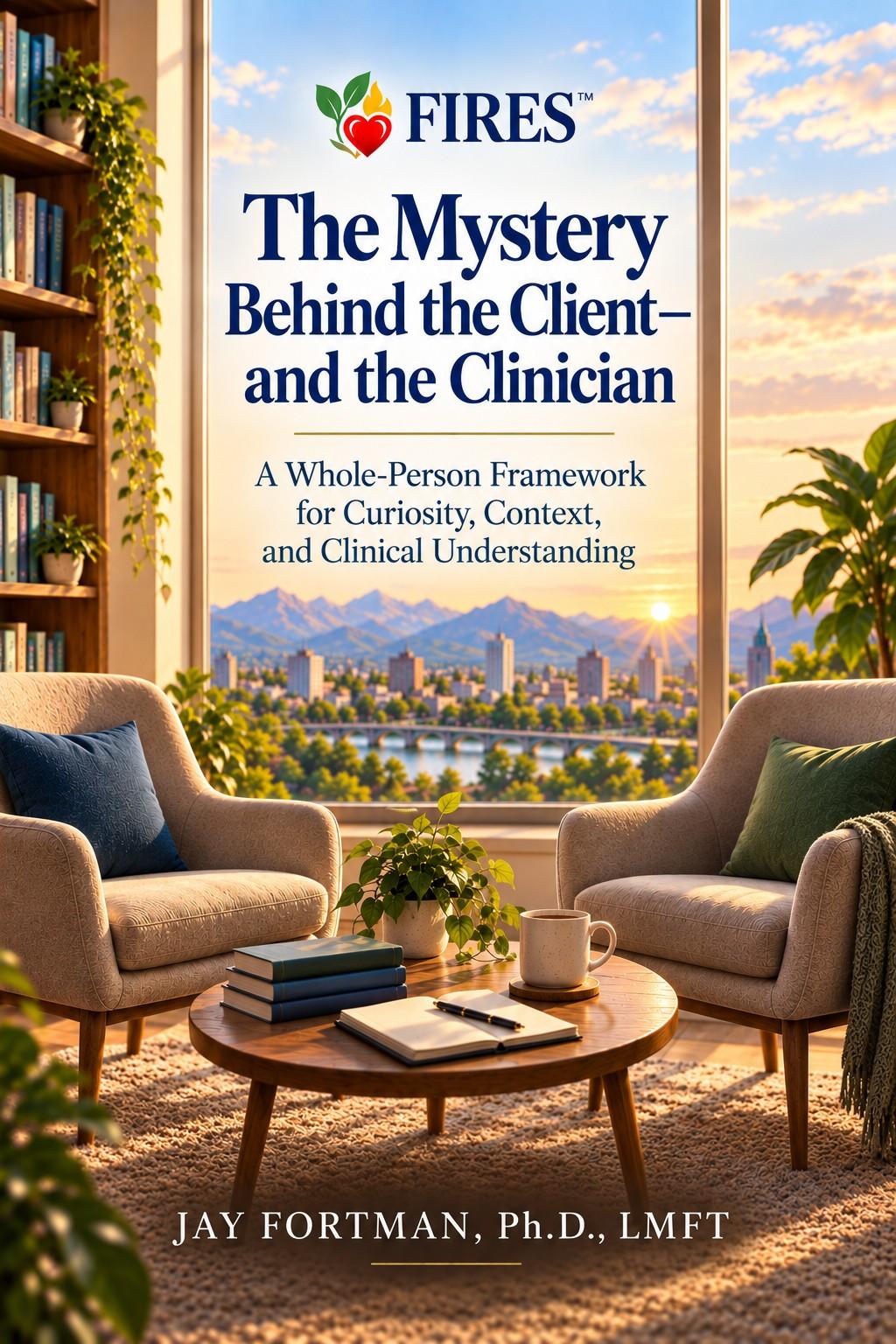
The Mystery Behind the Client—and the Clinician
A Practical Whole-Person, Nervous-System-Informed Framework for Clinical Practice
Jay Fortman, Ph.D., LMFT, School Psychologist
Interested in FIRES™ Continuing Education?
JOIN THE INTEREST LISTBe notified when The Mystery Behind the Client—and the Clinician becomes available and receive updates about future FIRES professional education and workshops.
Why This Course?
Why can the same client demonstrate an ability in one moment and have much more difficulty accessing that same ability in another?
Why can someone understand something clearly in the therapy room and struggle to access that same understanding during conflict?
Why does something seem manageable one day and much harder another?
FIRES™ begins with these kinds of ordinary clinical mysteries.
Rather than moving too quickly from an experience to a conclusion about the person, FIRES invites clinicians to become curious about what is happening, what may have changed, and what else may be shaping the moment.
Experiences are clues, not conclusions.
About the Course
FIRES™: The Mystery Behind the Client—and the Clinician is a practical, whole-person, nervous-system-informed continuing education course designed to help clinicians remain curious about the person in front of them and understand why the same person may function very differently across moments and conditions.
Participants begin with lived experience, treat experiences as clues rather than conclusions, consider the Five FIRES Domains™ as places to look, compare changing Access across moments, and use HELPS™ — The Detective and RESET™ — The Scientist to develop and revise working ideas.
Throughout the course, one principle remains central:
The model should remain smaller than the person.
What You’ll Explore
Experiences as Clues
Five FIRES Domains™
State vs. Trait
Ability vs. Access
Load, Strength & Impact
HELPS™ — The Detective
Record → Compare → Connect
RESET™ — The Scientist
Discovery
The Evolving FIRES Game Plan
The Clinician Is in the Room Too
Whole-Person Context
The Clinical Movement
- 1Notice
- 2Strength + Impact
- 3HELPS™ — The Detective
- 4Record → Compare → Connect
- 5Working Idea
- 6RESET™ — The Scientist
- 7Discovery
- 8Evolving FIRES Game Plan
Notice the person. Stay curious about what’s happening. Let what happens teach you something.
Designed for
This course is intended for mental health and related professionals, including:
LMFTs • LCSWs • LPCCs • Psychologists • School Psychologists
Course format
3 Continuing Education Hours
Self-paced, asynchronous written course.
The course includes: original FIRES™ instructional material, clinical examples, FIRES diagrams, EXPERIENCE IT exercises, APPLY IT CLINICALLY sections, references, a post-test, and course evaluation.
Completion requirements include reviewing the required instructional material and learning activities, completing the post-test with the required passing score, and completing the course evaluation.
Learning Objectives
Upon completion, participants will be able to:
- 1Differentiate between observing an experience and drawing a conclusion about the person experiencing it, using the FIRES principle that experiences can function as clinical clues.
- 2Identify the Five FIRES Domains—Feelings, Interest, Restoration, Environment, and Sensory—as areas clinicians can consider when gathering information about conditions surrounding an experience.
- 3Apply HELPS™ — The Detective to organize information about Feelings, Environment and Sensory conditions, Level of Restoration, Purpose/Interest, and Support without assuming that the presence of a condition establishes its clinical significance.
- 4Differentiate State from Trait and Ability from Access when considering variable functioning across situations and moments.
- 5Distinguish Load, Strength, and Impact and use comparisons across experiences to identify conditions that may warrant further clinical exploration.
- 6Apply RESET™ — The Scientist—Explore, Try, Observe, Learn—to a working clinical idea while incorporating new or contradictory information rather than treating the initial idea as a conclusion.
- 7Describe how information gathered across experiences and whole-person context can contribute to collaborative Discovery and an evolving FIRES Game Plan without treating emerging patterns as fixed conclusions about the person.

Your instructor
Jay Fortman, Ph.D., LMFT, School Psychologist
Dr. Jay Fortman is a licensed marriage and family therapist, school psychologist, educator, and developer of the FIRES™ framework.
For more than 50 years, his work has included schools, private practice, university teaching, professional training, and workshops with children, adolescents, adults, families, educators, and clinicians.
His professional experience is joined by lived experience—including childhood hearing loss and recognition of ADHD in adulthood—which contributed to his longstanding curiosity about why the same person can experience and function so differently under different conditions.
His doctoral dissertation, Children Under Stress: A Multimodal Approach, was completed at the University of California, Santa Barbara.
More about Dr. JayInterested in FIRES™ Continuing Education?
Be notified when The Mystery Behind the Client—and the Clinician becomes available and receive updates about future FIRES professional education and workshops.
JOIN THE INTEREST LIST
Important scope note
FIRES™ is a clinical and educational organizing framework. It accompanies established clinical assessment, diagnosis, formulation, and treatment; it does not replace them.
FIRES is not a diagnostic instrument, validated assessment tool, or stand-alone treatment model. It does not replace comprehensive assessment, crisis or risk procedures, medical evaluation, or other established standards of care.
Clinical examples are illustrative. Participants should apply the material within their professional scope of practice, competence, licensure, ethical responsibilities, and applicable laws and regulations.